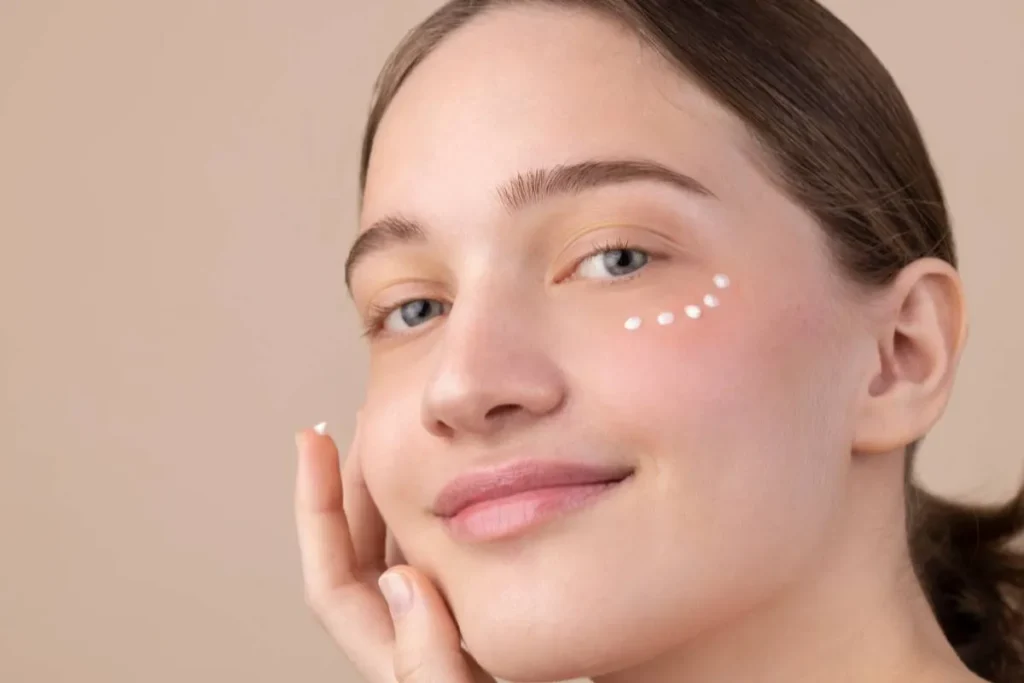
In short: A hyaluronic acid cream has an effect – but mainly on the surface. It binds water in the uppermost layer of the skin, making the skin appear smoother and plumper immediately. What it can't do is deliver large hyaluronic acid molecules into the deeper layers where skin aging actually occurs. This is because there's a tough barrier in the way. To reach the deeper layers, a physical method is required – through microneedles, fine channels, or an injection.
Hardly any active ingredient is advertised as much as hyaluronic acid. Almost every moisturiser contains it. The question is justified: is it effective, or is it marketing? The honest answer has two parts.
The barrier that hardly anyone knows
Your skin has a protective layer on the outside: the stratum corneum. It's only fractions of a millimetre thin, yet it's an astonishingly dense barrier. Its job is to keep foreign substances out and moisture in. This is precisely what will be the undoing of the hyaluronic acid cream.
Whether a molecule penetrates this barrier depends heavily on its size. And herein lies the problem: classic hyaluronic acid is a very large, water-loving molecule. Studies show that high-molecular-weight hyaluronic acid remains on the stratum corneum, while only low-molecular-weight, i.e., smaller, hyaluronic acid actually reaches the upper layers. It practically does not penetrate to the dermis, where collagen and elastin are located, through mere application.
Why this doesn't mean cream is useless
Now for the fair side. The surface effect is real and valuable. Hyaluron in the cream attracts water and forms a moisture-binding film. The skin feels smoother, fine lines caused by dryness appear reduced, and the complexion looks fresher. This is beneficial for daily skincare and an intact skin barrier.
You just need to know what you're buying: a cream is surface care. It doesn't replace what happens in the depths – and it doesn't seriously promise to.
How active ingredients really get into the depths
For an active ingredient to work in the dermis, it must physically penetrate the stratum corneum. There are several established methods for this:
Microneedling. The finest needles create tiny channels in the skin. Two things happen simultaneously: the channels trigger a natural repair response, and they briefly open a pathway for active ingredients to penetrate deeper. More on this at SkinPen®.
Spicules. These are microscopically fine, needle-like structures from sea sponges. When applied, they create countless micro-channels in the stratum corneum, thereby improving the absorption of active ingredients. A purely physical principle, completely without equipment.
Injection. The most direct way. The active ingredient is placed precisely where it is intended to work – in the skin itself – with a fine needle. This is how skin boosters work: NCTF® and Polynucleotides.
Further physical methods. Methods such as iontophoresis or ultrasound are also used, to specifically make the barrier more permeable.
| Supply | Where the active ingredient ends up | What is it suitable for? |
|---|---|---|
| Cream | Horn layer (surface) | daily care, external moisture |
| Microneedling | Upper to mid-skin | Texture, repair stimulus, active ingredient absorption |
| Spiculae | upper skin over microchannels | Active ingredient absorption, skin appearance |
| Injection | directly in the skin | Moisture and regeneration in depth |
What this means for polynucleotides and hyaluronic acid
The same principle explains why polynucleotides and deeper-acting hyaluronic acid treatments are injected rather than merely applied. Their site of action is the dermis – and they don't reach it through a cream, but only by physically overcoming the barrier.
This isn't a case of „cream good, injection bad» or vice versa. They are two levels: the cream nourishes externally, the treatment works internally. It makes the most sense for both to work together.
How we proceed in the clinic
In the alestetics® In our Zurich clinic, we consciously combine both levels. For the surface and barrier, we use HydraFacial™, among other things. For the depth, we work with microneedling.SkinPen®the moisture complex NCTF® and Polynucleotides.
What your skin truly needs, we see in the depths – in the free AURA 3D Skin Analysis.
Read on
- Hyaluronic acid: cross-linked vs. non-cross-linked explained simply
- Polynucleotides or hyaluronic acid: what is better for skin quality?
- What are polynucleotides?
Does a hyaluronic acid cream really make a difference?
Yes, on the surface. It binds water in the uppermost layer of the skin, making the skin appear smoother and fresher. However, hyaluronic acid barely penetrates to the deeper layers of the skin, where collagen is found, just by applying it.
Why doesn't hyaluronic acid from the cream penetrate deeply?
Because the horny layer is a dense barrier and classic hyaluronic acid is a very large molecule. Large molecules remain on the surface; only smaller ones penetrate slightly further into the upper layers.
How do active ingredients get into the deeper layers of the skin?
Via a physical route: microneedling and spicules create fine channels, while an injection directly places the active ingredient into the skin. This allows deeper treatments to reach the dermis.
What are spicules?
Microscopically fine, needle-like structures from marine sponges. On the skin, they create countless micro-channels in the stratum corneum, thereby improving the absorption of active ingredients.
Is cream or injection better?
Both have their place. The cream nourishes the surface and the barrier, while the injection brings moisture and regeneration to the deeper layers. The combination is most effective.