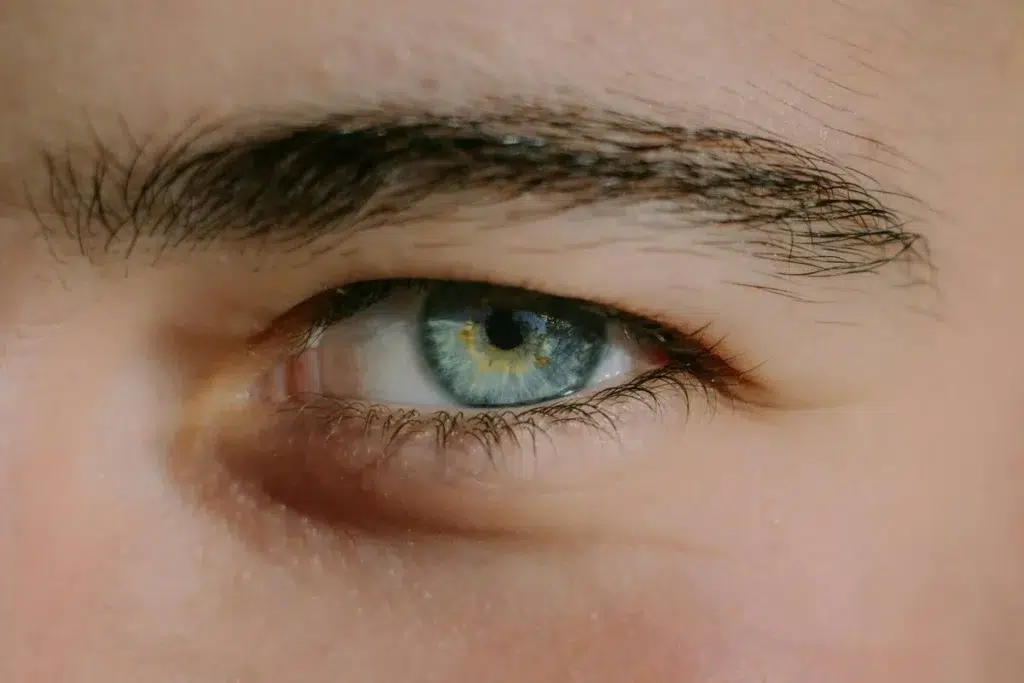
In short: The skin under the eyes is particularly thin – and that's precisely where polynucleotides can come in. They improve the quality and density of the eyelid skin, which can help reduce a tired, shadowed appearance. It's important to have realistic expectations: polynucleotides are not fillers. They don't plump up tear troughs with volume. For dark circles caused by thin, poor skin quality, they are very effective; for dark circles due to pigment, blood vessels, or volume loss, other or supplementary approaches are needed.
Dark circles are one of the most common concerns — and one of the most misunderstood. Before we talk about polynucleotides, we need to briefly clarify what actually causes dark circles. Because what helps depends on that.
Why the eye area is a special case
The skin around the eyes is the thinnest on the entire face. It has fewer sebaceous glands, loses moisture more quickly, and becomes thinner and duller earlier with age. What lies beneath – vessels, shadows, the bony structure – therefore shows through more prominently.
This is precisely why the eye area reacts so sensitively and requires its own gentle approach.
Dark circles under the eyes don't have one single cause, but several.
To manage expectations, here's the breakdown. Dark circles under the eyes are usually caused by a combination of:
- Thinner, poor skin quality — the eyelid skin is pale and thin, shadows show through
- Pigment — brownish discolourations, often inherent
- Vessels bluish-purple shadows through translucent blood vessels
- Structure and volume — a pronounced tear trough casts a shadow
No single method solves all four at once. Those who understand this choose more precisely – and will not be disappointed.
What polynucleotides can do for the under-eye area
Nucleotides tackle the root cause: skin quality. They stimulate the cells of the eyelid skin, improve density and elasticity, and provide moisture. Denser, better-hydrated eyelid skin makes underlying shadows less apparent and gives a fresher look.
The study findings are interesting: In a randomised, double-blind, split-face study of the eye area, polynucleotides improved elasticity and moisture, and showed a benefit in skin roughness and pore formation – without severe side effects. Formulated seriously, this means: In the majority of cases examined, the skin quality of the eye area improved.
Polynucleotides not You do not fill a tear trough with volume, nor do you resolve a purely pigmentary or vascular cause. You are not a filler – and do not wish to be.
PolyPhil™ Eye — the variant for the eye area
For this zone there is a specific formula: PolyPhil™ Eye, specifically adapted for the delicate skin around the eyes. The goal is firmness and hydration for tired, thin eye areas – without the risk of a filler. We explain the difference to the other PolyPhil™ variants in PolyPhil vs. PolyPhil Next.
How the treatment proceeds
We apply PolyPhil™ Eye with the Vital Injector 2™ at a controlled, shallow depth – without wheals or micropapules. Because the skin should do the work itself, a short series is usually recommended. In the short term, slight redness or swelling is possible, which subsides quickly.
Whether your dark circles are a skin quality issue at all – or rather pigment, vessels, or structure – we'll clarify that first. That's precisely what the free AURA 3D Skin Analysis da. More on the subject on our page about Dark circles and eye bags.
Read on
- Under-eye bags & dark circles – an overview
- PolyPhil vs. PolyPhil Next: which variant for which skin?
- What are polynucleotides?
Can polynucleotides help with dark circles under the eyes?
They help with dark circles that come from thin, pale skin quality: polynucleotides improve the density and moisture of the eyelid skin, making shadows less visible. For pigment, vascular, or volume-related causes, other or supplementary methods are needed.
Are polynucleotides under the eyes a filler?
No. Polynucleotides are a skin booster that improves skin quality. They do not fill tear troughs with volume and do not change the shape.
Which variant is used for the eyes?
For the delicate eye area, there is PolyPhil™ Eye, a specially adapted variant with a lower concentration. It targets firmness and hydration of the thin eyelid skin.
How many sessions do you need?
A series of initial sessions is usually recommended, followed by occasional top-up treatments. The exact frequency depends on the skin's condition.
How many sessions do you need?
A series of initial sessions is usually recommended, followed by occasional top-up treatments. The exact frequency depends on the skin's condition.
Does the treatment hurt your eyes?
The treatment is performed at a shallow depth with the Vital Injector 2™ and is found to be well tolerated by most.