
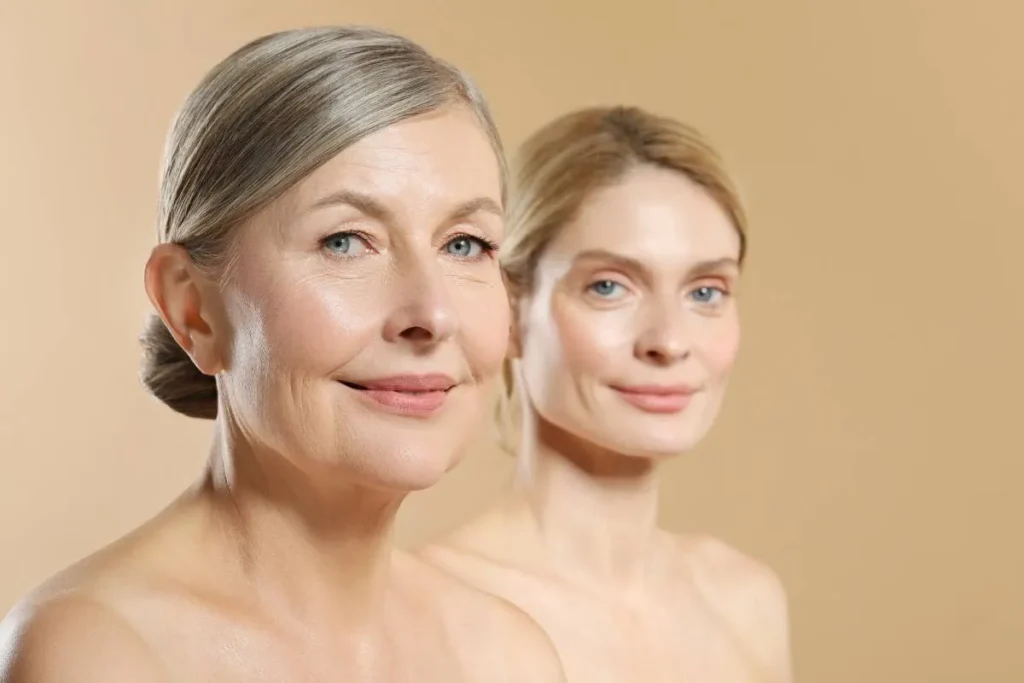
Twenty years ago, this was a topic for a select few. Those on stage or in front of the camera had something done. Everyone else waited and reached for the cream when the first wrinkle appeared.
Today things are different. People who pay attention to their sleep, what they eat, and their exercise are now asking the same question about their skin: How do you stay healthy for a long time? This is the moment when Longevity – the thinking about a long, good life – has arrived in the skin. And this is where Longevity differs from other approaches to skin care. Pre-ageing from anti-aging.
What «Anti-Aging» actually says
The word betrays the attitude. Anti is the opposite. Anti-ageing begins when there's already something you want to fight – the wrinkle, the blemish, the loss of firmness. It's repair. And the promise that often resonates with it is reversal.
That's where it gets difficult. Many things that the skin has lost over the years cannot be fully restored afterwards by any active ingredient. Those who only react when the damage is visible have already left the easier part of the journey behind.
Pre-aging ist Skin Longevity
Pre-aging reverses the order. Instead of waiting for something to show, it's about maintaining the skin's quality while it's there – its density, its elasticity, its complexion. Skin longevity instead of damage control.
That sounds unspectacular, but it's the crucial difference. Skin that is well looked after early on has much less catching up to do later. Skin Longevity means investing in skin quality before you miss it.
Your skin ages – but for the most part, you have control over it
Part of skin ageing is due to genes. The larger part comes from external factors. Researchers group these external influences together under the term exposome – sun, environmental pollution, smoke, diet, lifestyle (Krutmann et al., 2017). For the face, one figure is particularly striking: up to 80 percent of visible signs of ageing are due to external factors, especially the sun (Flament et al., 2013).
That's good news. What comes from outside can be influenced.
One exception is important: The sagging of contours, the laxity, has less to do with the sun and more to do with gravity and the structure beneath the skin. This distinction—surface versus structure—will crop up again shortly, in a place where it changes everything.
The face is a mirror
How old someone looks is more than just their appearance. In a large twin study, a person's estimated age was linked to their underlying health, down to measurable markers of cellular ageing (Christensen et al., BMJ 2009). Therefore, skin quality is not a superficial issue. It externally demonstrates how the skin is actually doing.
The surgery idea – then and now
For a long time, a simple notion prevailed: you live with the skin you have, and at some point, at 50 or 60, you have an operation. The operation was the plan.
Today, it no longer does – not because it's incapable, but because it only affects one level. Surgery tightens the structure. It does not tighten skin quality.
This is where the distinction from before comes back. Laxity is on the structural level. Skin quality – density, texture, elasticity, complexion – is the surface everyone sees. Even a very good surgical result works with precisely the skin that lies over it. If this skin is thin and lacking in vitality, the result will appear less convincing.
That's why you can't avoid skin quality, no matter which path you take later. Those who work on it early keep their options open. You are not forced into anything. And if you do decide on a structural intervention at some point, the foundation for it is good. Pre-aging excludes no path – it is the foundation that makes every path look better.
What pre-aging looks like at alestetics
Pre-aging begins with knowing your skin, not with random treatments. For us, it starts with AURA 3D Skin Analysis: a three-dimensional look at the surface, structure and dynamics of your skin. This leads to a plan that suits your skin type and age – free and without obligation.
We build on this. Instead of filling from the outside in, our treatments stimulate the skin to produce its own collagen – for example, with monopolar radiofrequency lifting, such as Volnewmer® or with SkinPen® Microneedling. Why collagen is the central building block in this and why it declines from the mid-twenties onwards is a topic in itself – we'll come back to that elsewhere.
The best time to start pre-aging is earlier than most people think. The second best time is today.
Studies & Sources
- Christensen K, Thinggaard M, McGue M, et al. Perceived age as clinically useful biomarker of ageing: cohort study. BMJ. 2009;339:b5262. — PubMed
- Krutmann J, Bouloc A, Sore G, et al. The skin aging exposome. J Dermatol Sci. 2017;85(3):152–161. — PubMed
- Flament F, Bazin R, Laquieze S, et al. Effect of the sun on visible clinical signs of ageing in Caucasian skin. Clin Cosmet Investig Dermatol. 2013;6:221–232. — PubMed
What is the difference between pre-aging and anti-aging?
Anti-aging starts when visible signs are already present and attempts to combat them. Pre-aging works beforehand: it preserves the quality of the skin – density, elasticity, and complexion – for as long as it is present. The effort is less and the result lasts longer, because the skin doesn't lose as much in the first place.
What does longevity have to do with skin?
Longevity stands for a long, healthy life. Those who pay attention to nutrition, sleep, and exercise are increasingly considering their skin as part of their overall health. Skin quality is a visible marker of how the skin is truly doing.
Do I need pre-ageing procedures or an operation?
No. Pre-aging works on skin quality, not structure. Surgery affects a different level and remains a later, personal decision. Good skin quality is the foundation that makes every path look better – including one without surgery.
When should one start pre-aging?
The sooner, the less effort later. From the mid-twenties onwards, the skin begins to lose substance, long before any visible signs appear. It is precisely in this phase that prevention is most effective.
Sources & Studies
The statements in this article are based on the following scientific publications:
- Christensen K et al. (2009). Perceived age as clinically useful biomarker of ageing: cohort study. BMJ. PubMed 20008378
- Krutmann J et al. (2016). The skin aging exposome. J Dermatol Sci. PubMed 27720464
- Flament F et al. (2013). Effect of the sun on visible clinical signs of aging in Caucasian skin. Clin Cosmet Investig Dermatol. PubMed 24101874
