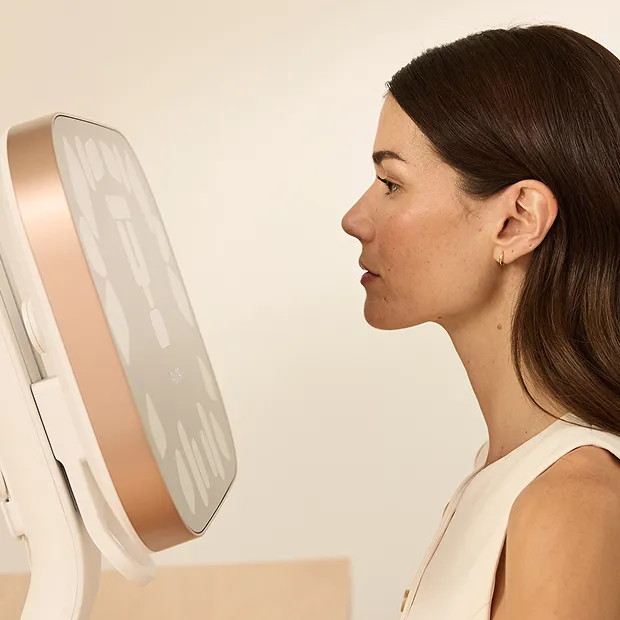
Both systems are highly accurate – but they address different questions. VISIA is a multispectral camera that measures your skin’s surface and underlying colour signatures across eight markers and compares them against a vast database of reference data. AURA 3D creates a true three-dimensional digital twin of your face and also analyses volume and lifting potential. Which is „more precise» depends on what you want to know.
In Zurich, almost all clinics offering „skin analysis» use the same device: VISIA. It’s an excellent system – but hardly anyone explains what it actually measures and where its limitations lie. That is exactly what we do here: an honest, technical comparison of the two leading approaches, so that you can understand which analysis is right for your needs.
What both systems have in common
Whether it’s VISIA or AURA 3D – both have the same goal: to turn your hunch into data. Instead of simply stating that „the skin looks dry», both provide objective, reproducible, and photographically documented measurements. Both use standardised lighting, meaning that images can be fairly compared over a period of months. And both use AI-powered analysis to turn the image into a clear diagnosis.
The key point is that a proper analysis is never just about the device itself. It forms the basis for a Plan – and that only happens when an experienced professional interprets the data in the context of your goals.
VISIA – the multispectral camera (the gold standard for skin analysis)
VISIA by Canfield Scientific has been the international standard for Skin analysis. The system captures your face using three types of light – standard/white light, cross-polarised light and UV light – and uses this to measure eight skin characteristics (according to Canfield Scientific):
- Stains (Adverts) · Folds · Texture · pores
- UV stains (Sun damage that becomes visible beneath the surface)
- Brown spots and red areas – shown separately via Canfields RBX technology, isolating the red (vascular) and brown (pigmented) colour signatures beneath the skin’s surface
- Porphyrins – bacterial deposits in the pores, an early indicator of acne-prone skin, made visible by UV fluorescence
The real strength of VISIA: it compares your results percentile-based, using one of the world’s largest skin databases – against people of the same age and skin type – and uses this to estimate a „skin age» (TruSkin Age). The UV absorption data also provides the most comprehensive set of data available on sun damage.
How reliable is that? In a precision study published in 2022, the measurement deviations between two readings ranged, depending on the criterion, from below 2 % (texture, UV spots, brown spots, porphyrins), between 2–4 % (pores, red areas) and around 6 % (spots, wrinkles) – overall, very good reproducibility.
Important and honest: At its core, the classic VISIA is a 2D multispectral camera (Although it renders the interface in a rotatable format, it does not capture true 3D geometry). Although a new VISIA 3D model has been available since March 2026, most clinics still use the established 2D system.
AURA 3D – the digital twin (Swiss-made by Hexagon)
AURA 3D takes a fundamentally different approach. The system – developed and manufactured in the Switzerland by Hexagon, the global specialist in reality technology – captures your face and your neck with 13 cameras in a single 0.2-second exposure, with an accuracy of 0.1 mm (Manufacturer's specifications: Aura/Hexagon).
This does not result in a photograph, but rather a photorealistic 3D digital twin – a „digital self» that you can freely rotate, zoom in on and view from any angle. The AI analyses in real time:
- Wrinkles and fine lines · Pores · Skin texture · Redness · Pigmentation (brown spots) · Skin tone · Skin ageing
- and – this is the crucial difference – Facial structure, volume, angles and distances, as well as lifting vectors, which demonstrate the firming effect of a treatment
VISIA answers the question: „What is the condition of your skin’s surface and its colour composition?» AURA 3D also answers: „What is the three-dimensional structure of your face – where is elasticity lacking, where is volume changing, and how would a treatment plan alter this?».
A direct comparison
| Criterion | VISIA | AURA 3D |
|---|---|---|
| Imaging | 2D multispectral (surface + subsurface colour) | A true 3D digital twin |
| Recording | Several flashes of light, face | 13 cameras, 0.2 s, face + neck |
| Geometric accuracy | not the focus | 0.1 mm |
| Skin marker | 8 standardised markers | Wrinkles, pores, skin texture, redness, pigmentation, skin tone, skin ageing |
| UV-induced sun damage & porphyrins (acne) | ✓ Core strength (UV fluorescence) | not the focus |
| Subsurface red/brown (RBX) | ✓ separately insulated | Redness & pigmentation, without RBX separation |
| Volume & Lifting Vectors | — | ✓ |
| Percentile benchmark vs. database | ✓ + Skin age (TruSkin Age) | Comparison of the history of your own scans |
| Origin | USA (Canfield) | 🇨🇭 Switzerland (Hexagon) |
| Ideal for | Skin tone, pigmentation, sun damage, acne-prone skin | 3D planning, lifting/tightening, volume, overall pre-ageing appearance |
Sources: Canfield Scientific (VISIA) · Aura/Hexagon (AURA 3D)
Which is „more accurate»? The honest answer
There is no single „best» skin analysis – there is the relevant to the question:
- Do you want to know how things are going with Sun damage, pigment-related issues, porphyrins/risk of acne and where you stand compared to your age group? → Then VISIA the more precise instrument. The multispectral and UV imaging, combined with the normative database, are unbeatable in this respect.
- Do you want the the three-dimensional shape of your face and neck understand – structure, volume, where there is a lack of tension – and see how a plan changes that over time? → Then AURA 3D the more precise instrument. A 2D camera cannot achieve 0.1 mm accuracy in true 3D, plus lifting vectors.
And the most important sentence: No device can replace the expert who interprets the data. In the hands of an experienced person, these same measurements result in a more accurate plan than if someone were simply reading out the printout.
Why we use AURA 3D at alestetics
Our work focuses on Pre-ageing, skin quality and firming – for example, using monopolar radiofrequency (Volnewmer). These treatments act on Bounce, texture and volume. That is exactly what AURA 3D measures in real depth: the face and Neck, lifting vectors, progression over time. The digital twin turns an abstract recommendation into something you you see – the basis of your Skin Quality Blueprint.
The fact that AURA is Swiss-made by Hexagon fits in perfectly with our ethos: Swiss precision – no hasty decisions, just a well-thought-out plan. VISIA is an excellent system – but for what we do, AURA 3D is the right tool for the job.
More about AURA 3D skin analysis at alestetics · All Prices at a glance
Frequently Asked Questions
Is a 3D skin analysis better than a VISIA analysis?
Not „better», but different. VISIA is more accurate when it comes to skin tone, sun damage and pigmentation, including a percentile comparison against a large database. AURA 3D is more accurate when it comes to three-dimensional structure, volume and lifting potential. Which one is right for you depends on your goal.
How long does an AURA 3D skin analysis take?
The actual consultation takes just 0.2 seconds. The in-depth discussion, during which we go through the findings together and develop your plan, takes considerably longer – around 60 minutes with us as part of the Skin Quality Blueprint.
How much does a skin analysis cost in Zurich?
In Zurich, standalone skin analyses usually cost between around CHF 100 and 250, depending on the system and scope. At alestetics, the AURA 3D analysis is included in the initial Skin Quality Blueprint consultation – free of charge. You can find the current terms and conditions on our Prices page.
Does the test hurt, and is it safe?
Both procedures are completely non-invasive, contact-free and do not involve X-rays – they use only cameras and light. The scan is quick and comfortable.
Will I be able to compare my progress later?
Yes. Both systems are reproducible. With AURA 3D, we compare your current digital twin with previous scans – so you can see changes objectively and in three dimensions, rather than just guessing at them.